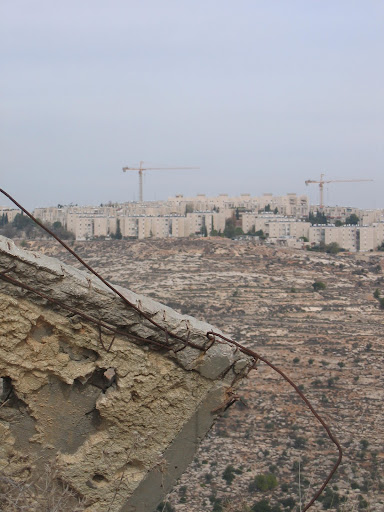
I spent this past Thursday and Friday in Bethlehem on a program called Encounter. I won't go through all the details of the trip, but I'll just try to highlight some of the sessions or thoughts that stick out in my mind, or that other participants pointed out and I found particularly compelling. If anyone wants to speak about anything in more detail, I'd love to over phone or email. I've been pushing off writing this post. It's a bit overwhelming, trying to fit everything in. Trying to process everything I saw and come up with some concise way to describe it all. But I figure that it's better to get something down than to just keep pushing it off, so here's my best shot.
Encounter
The purpose of the trip is to give future Jewish leaders, educators and rabbis the opportunity to speak to Palestinians and witness a bit of their lives outside of the filter of the media and the things we hear within our own community. I know there are people who would oppose even the existence of such a program, and I find that very difficult to accept. Yes, it's true that the people we spoke to have their own 'agenda' ( a word I don't really like to use) and probably slant certain facts. But if someone has political views that are more to the right and is unable to maintain his/her own beliefs while listening to the people we heard from and gain something from hearing their viewpoint then I think they must not know enough to support their own opinions - a problem in any case. I find the position that it is better to remain ignorant than to take on the challenge of grappling with the information available to us completely untenable. It is our obligation, as people, and especially as Jews, with a special connection to the land and the politics of the region, to gain as much information as we can and come to our own conclusions about the conflict and the policies of the people involved.
Because of the nature of the program, I will not really discuss very much about the problems caused by the Palestinians, especially terrorism. Please don't take this to mean that I condone terrorism in any form - I adamantly believe that any form of terrorism is morally repugnant. But this was a listening trip, and I think there's some value to that. We were told not to try to convince anyone about anything, but just to listen. That doesn't mean accepting everything we were told. Of course grappling with the information we received and deciding what to believe is part of the process. But I think it's a good exercise to be in a position of gathering information instead of always being on the defensive.
Difficulty of Expression
One of the reasons I've had difficulty writing this is that I know I will not be able to properly convey the experience. Most of us who have bothered to keep track of the politics in this part of the world will have heard all of the factoids and complaints before. We have been exposed to the Israel advocates' explanations of Israeli policies and the Palestinian protests and slogans. The special thing about this experience for me was the interaction. The experience of hearing from individuals. Gaining the ability to not just think of 'The Palestinians' as an abstract concept or the generalizations we maintain, but as people, individuals, with families and businesses and homes filled with little trinkets and disagreements with each other. I don't think that seeing Palestinians in this way automatically means that you change your opinions or views, but it certainly does make it more difficult to write off things like 'the wall/fence/barrier', checkpoints or military occupation and settlement as minor inconveniences necessary for the defense of the Israelis. There is nothing minor about them, and one thing that became clear from this experience is that anyone who wishes to maintain their support of any of these things, must have some very good arguments to explain why the benefits outweigh the difficulties that result.
Trying to See Through the Eyes of Another
Part of the reason I think that meeting with people in person makes a big difference is that it forces you to try to see the situation through their eyes. When we hear the positions of a group of people or even an individual through the lens of the newspaper or television, we are removed enough that we can easily maintain our own pre-conceptions and view the statement as an object that we can analyze with the tools and ideas we have already formed. It's much more difficult to objectify an opinion when it's being expressed by the person in front of you (also probably quite rude to do so).
For instance:
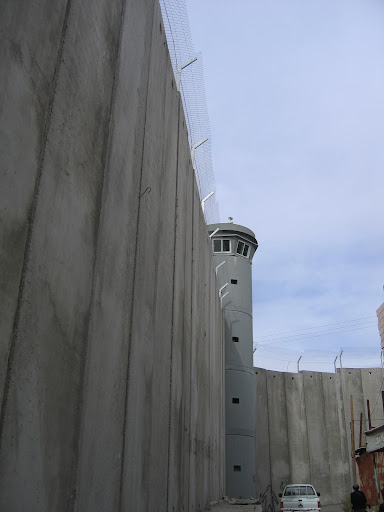
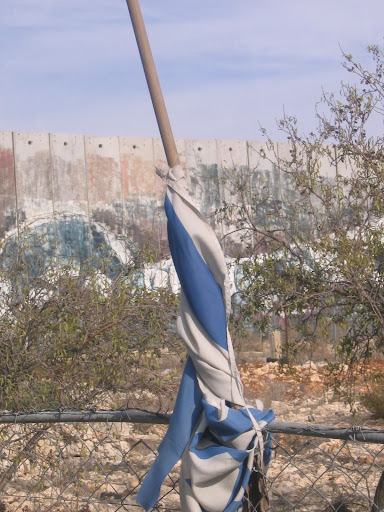
We focused a lot on the construction of Israel's security fence/barrier/wall in and around Bethlehem. We saw the places where it deviates from the green line with no apparent security reasoning. We followed the path of the wall where it cuts into Bethlehem in order to provide for Israeli passage to Rachel's Tomb with disregard for the houses that become blocked in, or the businesses that previously subsisted on business from tourists to the tomb that have now closed down.
We then heard from a number of Palestinians who claimed that they are completely sure that the wall is not meant for security. My opinion was that the idea of the wall is for security. My opinion still is that in essence, it is meant for security. However, many aspects of its route clearly have other, political, or religious motivations. The Israeli government is not a single person with a single voice. Getting political backing for certain moves sometimes requires that different groups, with competing motives are allowed to give input into things like the route of the barrier.
Here's where personal contact comes into play. After hearing from the people we spoke to, I completely understand their belief that it is not for security. I have no doubt that looking from their viewpoint, it would seem that Israel's motivation in building this barrier is to grab more land and pre-determine political boundaries. If my business closed because of the wall, or if I was now forced to use the side entrance of my house because the front door now faced a twenty foot slab of a concrete wall that could have easily been built 100 meters away, I would probably be pretty skeptical of claims that this wall was meant for security. So now, even though I maintain by belief in the justifiability of constructing a security barrier, my understanding of where Palestinian complaints are coming from has changed considerably. While I would continue to defend the construction, I would be more hesitant to dismiss complaints as mere political ploys.
What's in a Name
Along this same line of reasoning:
On Thursday evening we spent a couple of hours with a group of Palestinian youth leaders for the Holy Land Trust. We played some ice-breaker and peace games, but the more interesting part was the discussion groups. We spent a good deal of time speaking with a 23 year old Palestinian girl, Rana, about what we call this land. A few of us from the Encounter group distinctly recalled learning how to draw the map of Israel in elementary school. The teacher had carefully carved out the shaped of the entire area between the Jordan and the Mediterranean on the blackboard and we were told to practice drawing the shape of Israel. There was no mention of the fact that most of the world, and even the Israeli government itself does not consider all of that land part of the state of Israel. We were young and we took this picture of Israel to be a fact, same as our multiplication tables and science class.
Now, of course, Rana remembered the same lesson, except in her class, that same shape was called Palestine. Now I know there are lots of people who will jump on this story and say- Ha, see, I told you. All the Palestinians want is to destroy the state of Israel and throw all the Jews into the Sea. But that would be missing the point. My guess would be that Rana doesn't believe that this entire land will one day become a Palestinian state. She probably believes that some solution will split this are into Israel and Palestine. The point here is that she is just a young person like me. There is no ulterior motive or sneakiness in her belief that this land is called Palestine. She didn't sit and try to think of it or come to some important decision about it. She accepted it as fact, just as we did, and the idea of calling it Israel never even occurred to her. Now, of course, all parties involved probably need major revisions of their elementary school curriculum, but I think that the tendency of the American Jewish community to immediately shut out discussions with anyone who uses the word 'Palestine' is unwarranted, and a great way to make sure we never achieve peace.
Location
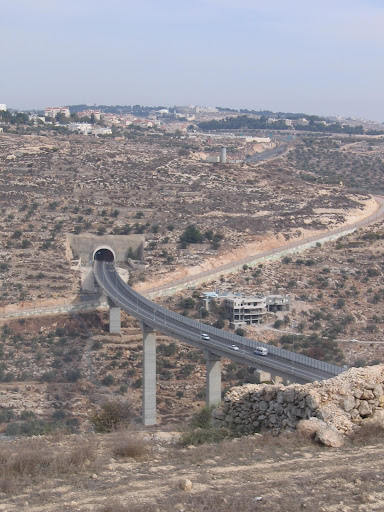
The fact that this trip took place in Bethlehem as opposed to another Palestinian city had some special significance for me. I spent the year before college learning in the Gush - technically considered an area of Israeli settlement. At that time, and up until this trip I put the Gush in a different category from other Israeli settlements. This is partially because it is generally believed that in a final settlement, the Gush is one of the areas over the green line that will most probably be incorporated into Israel proper. There also is the fact that this was an area that was inhabited by Jews until the 1948 war of Independence, and so the presence of Jews in that area is not a new development.
But what became clear on this trip is that while that separate category does have some justification, it does not mean that it is exempt from some of the criticisms of other settlement areas. It was especially difficult for me to hear about the difficulties endured due to expansion of certain settlements in the Gush, or to see the places where roads I traveled on frequently make life harder for individuals. This doesn't completely change my view of the Gush, but it did convince me that putting it in a different category is not necessarily a way out of having to thoughtfully consider the implications of that area of settlements.
Another personal point of difficulty was the proximity of Bethlehem to Jerusalem proper. On our return trip we drove through the gate in the wall that's near Rachel's tomb. It was like going through a portal to another dimension. One moment we were in the city of Bethlehem, which while more prosperous than many Palestinian cities (in some ways I was expecting much worse), is still a poor and run down looking place and the next we were in the industrial Talpiyot district of Jerusalem, just minutes from my apartment. The fact that this other world exists so close to my own, and that in some ways the relative ease and safety in which I can live here is made possible by the roadblocks and walls which make life for some so difficult is something which I can't get out of my mind.
Images
A few images that stuck with me or other participants:
The Israeli soldier who came on the bus to check that we were all American on our way back into Jerusalem. The smile on his face. The "Shabbat Shalom." We had just come from two intense days of hearing about the difficulties endured by people, often with the Israeli soldier as the symbol of the source of that suffering. It might have been easy to be angry at this soldier. To use him as a representative of all the problems with the Israeli policies. But he was just a person, just like all the people we had just met. He puts his life in danger every day to protect me. He follows orders. He is innocent.
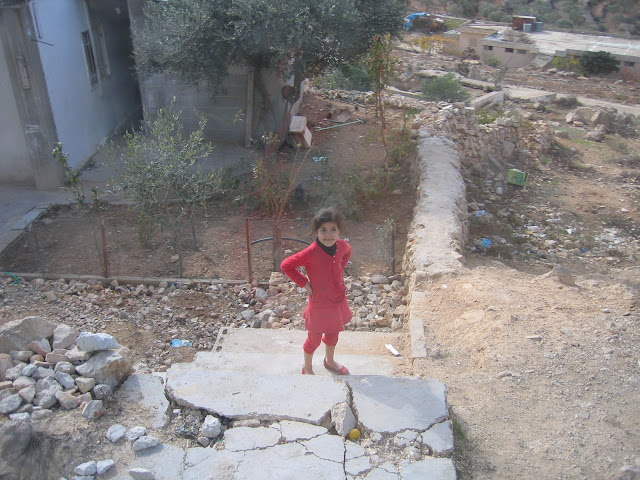
The children. We saw children from a range of socio-economic backgrounds. The 11 year old girls at the Hope Flower School - a private school. They were typical, crazily hyper 11 year old girls. The kids in the village of Al Walaje, playing outside the concrete squares that are their homes. Smiling and waving. It's amazing how children can be happy no matter what situation they're in.
We got the chance to meet with some truly amazing and inspiring people. Azziz amazed me. After his brother was wrongly jailed by Israel and died from medical neglect while in prison, he started getting involved with groups that resorted to violence to resist the occupation. But at some point, he decided to not allow the situation he was placed in to make his decisions for him. He is now part of a group of families who have had family members killed in the conflict - on both sides. He is a peace advocate who travels to both Israeli and Palestinian to spread to message of peace and the possibility of co-existence. We met with a number of people who had similar stories. They chose to follow a path of peace rather than resorting to the violence that surrounds them. In some ways, this may be a flaw of the program. It's quite easy to come out of the program believing that every single Palestinian wants nothing more than peace with Israel, which is obviously not true. But I think if we are aware of that, then there is something nice about coming away with some hope for peace.
Loving Israel
At a certain point on the trip, I felt the most intense love for Israel that I've felt in a long time, maybe ever. But this feeling came in a very particular form - of fear of losing Israel. I was thinking about what will happen in the next fifty years. Suppose nothing changes. Suppose settlements continue to expand, to the point where Palestinians are forced to leave, or are chased out, and in fifty years, this entire piece of land is Israel proper. If that were to happen during my lifetime I think I might be unable to come here. I would lose Israel. And that is terrifying for me. I suddenly realized how important Israel is to me, and how horrible it would be to lose it.
I've been searching and speaking to people since the trip, trying to understand what people who support settlement expansion plan for the future. Those who believe that we are obligated by our religion to settle all of this land and kick out all the other inhabitants - I understand and don't really have anything to respond. I can say - just remember that you choose to believe that, and there are many religious authorities who disagree, who you could choose to follow instead. But if that is their belief, then I can't refute it. But anyone else, I don't really understand. The only options I can seem to come up with are: a) maintaining the status quo - not only a bad idea from the standpoint of security, but also morally problematic to have a military occupation over another people who have no citizenship in Israel while Israel claims to be a democracy. b) annexing - ie one state - and giving all Palestinians citizenship - not something most Jewish people would embrace since the Jewish people would quickly become a minority in Israel, which would lose its status as a Jewish state, and who knows if we would even have a place here. c) removing all Palestinians - morally completely unacceptable to knowingly kick people out of their homes while they are not even citizens of the country doing it. While removing people from settlements is also an extremely sad process, at least the people there are citizens of the country doing the removal. They got to vote in the election that put this government in power, and in doing so, they relinquish some of their rights, while the Palestinians have no such voting rights. d) Two states - this is the only one that seems an acceptable option, and continually expanding settlements is making this less and less possible. Already, the West Bank would be a strangely shaped piece of land for a country, with holes eaten out of it by Israeli settlements. A little more time, and it will be nearly impossible to create a state there without the withdrawal of hundreds of thousands of settlers.
So even just logically (ie - putting political beliefs and tit-for-tat arguing aside), I haven't yet heard an argument in support of settlement with a rational plan for the future - if anyone has one, please let me know.
This is far from a complete description, but already this is quite a long post, so for now I'll leave it here. As I said in the beginning - let's talk over phone or email.



No comments:
Post a Comment