I didn't come to Israel to learn Hebrew. The truth is I originally planned on not taking any Hebrew lessons, but when I was in Thailand this summer, there were lots of Israelis and lots of Hebrew, which made me realize how out of practice I am. So I decided I would take some classes or tutoring just to make sure I can keep up in art class. But through speaking Hebrew and the tutoring sessions I've been taken, I've actually come to see a beauty in the Hebrew language that I've never seen before.
In particular, what I'm referring to is the way that Hebrew is centered around the usage of a relatively small set of root words known as Shorashim. This small vocabulary is then conjugated in a myriad of ways in order to create a complete language. It's really quite amazing when you start to realize all the connections between different words.
For instance, the verb "to follow" is Le'Akov לעקוב. The shoresh (root) can be conjugated into a noun as Akevot עקבות which means footsteps, as in to follow in someone's footsteps. The shoresh itself is Akev עקב which means ankle, also the origin of the name Jacob, or Ya'akov.
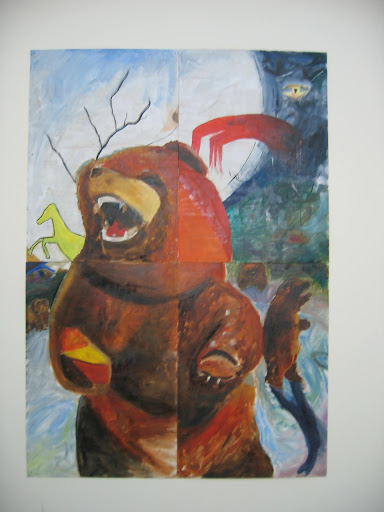
Another nice example, which I'll be dealing with a lot I'm sure, is the word Moof-shat מופשט , which means 'abstract.' It is derived from the root word meaning simple, or to simplify, which can also be conjugated to mean 'to undress' since undressing is returning to our plain and simple bodies.
This trait of Hebrew gives it a feeling of cohesiveness but also a sense of being tied to tradition, and a difficulty moving forward. I'll explain. Because everything revolves around this core of root words, it seems to me (keeping in mind that I know very little about the history of the language, or language development in general, of course) that it is quite difficult to introduce new words into the language, because you can't just add in a new root word to the somewhat rigid body of existing roots. Therefore, modern words in Hebrew generally don't sound very Hebrew at all. Technology is Technologia, conceptual is conceptuali, lithography is litografeea etc. etc. etc. These words have such a different feel from actual Hebrew words, that it's almost humorous to listen to a lecture on theories of art, or philosophy, since every other word is basically in English. While that does make it much easier for me to understand such lectures, it also feels like a bit of a cop out, as if there's this thin veneer of modernity layered over an ancient and traditional core.
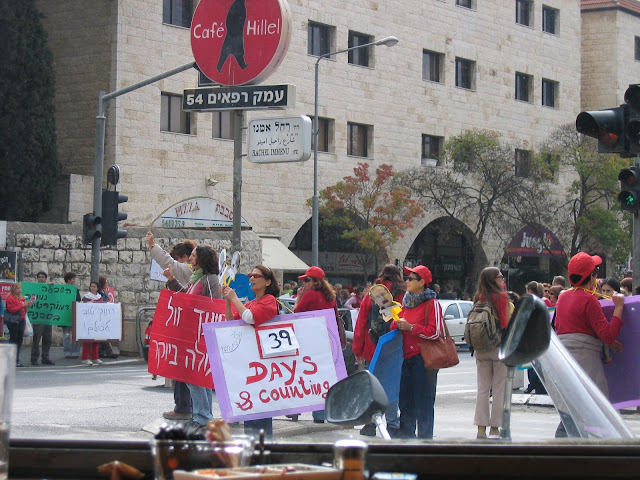
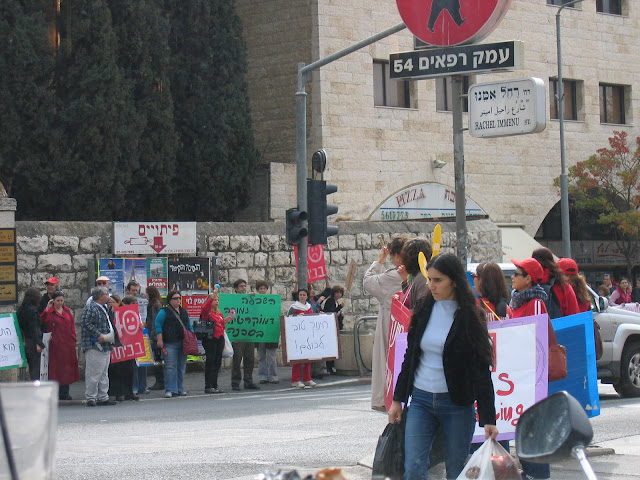
I guess that seems to be a good description of the land of Israel itself. Ostensibly, it's a modern (moderni), technologically advanced (mitkadem b'teknologia?) society. But there's an underlying core which is mired in the past. It's especially obvious in Jerusalem, where walls and buildings from thousands of years ago still stand next to modern high-rises capturing the interest and religious devotion of the masses, and street names recall biblical heroes and historical achievements. But even the country as a whole, is still very much centered around traditional and enduring ideas. Maybe the best example is the one that's central in any Israeli's mind and is entwined with the existence of the state itself - the struggling and fighting between the inhabitants of the land that has been going on for millenia.
There are those (in the linguistics/psychology world) who believe that language is so fundamental to human existence, that the forms of our language actually impact our thoughts, and in that way become more than just a means of communication. Language is central to the workings of our minds, the ways we organize our worlds and our modes of interaction. Not sure I would have the gall to make such a grand claim about this observation of mine, but there certainly is a strong and deep connection between the language and the land.
(I won't claim these observations are original. Many people who either study languages, or maybe even anyone who actually sat through high school Hebrew classes instead of sneaking out to play ping-pong in the student lounge may have noticed all this. But since I don't fall into either of those categories, I find this pretty interesting.)
Finally, (this comes from Sarah) there may be some interesting connection here to the topic of abstraction I've been thinking about. There are lots of different words, with minor differences in spelling or pronunciation, which make up the Hebrew language. However, if we weed out those small details, and 'abstract' up a few levels, we are left with just the more general shorashim, the root words which encompass the basic human activities and thoughts. Perhaps exploring the language at the level of the roots will give some insight into our basic desires and actions.

Subscribe to:
Post Comments (Atom)


1 comment:
I don't know nearly enough about the language to say anything conclusively, but your observations are astute. The history of 'shorashim' is complex, dating back to Biblical and pre-Biblical times, when dozens of Semitic languages/dialects were spoken in the Ancient Near East (i.e., the Middle East). It is likely that many shorashim share a common meaning, but there are also many shorashim that sound alike but never had any connection between them - this is not suprising, since, assuming tri-literal roots composed of about 2 dozen consonants, there are limitations on variety. As far as I understand, Classical Arabic, along with some Arabic dialects still spoken in remote regions of the Arab world, best preserves the linguistic elements of Semitic family of languages.
Post a Comment